
What if Someone Borrows My Car and Crashes It?

What if someone borrows my car and crashes it?
Picture this: A close friend or relative is temporarily without a vehicle and has several errands to run. You lend them your car. A few hours later, they call to tell you they were in an accident. They are okay, but your vehicle is damaged. Now you may be wondering who is responsible, whose insurance applies and what you should do next.
This article explains what vehicle owners and borrowers should do after a crash and how auto insurance may respond when someone else was driving your car.
What should you do first after a borrowed-car accident?
If you receive a call that your vehicle was involved in an accident, start with safety and documentation before discussing payment or fault.
Check for injuries and call 911 if needed. Get emergency help if anyone is hurt or if there is a road hazard.
Contact law enforcement. Depending on the location and severity of the crash, the borrower may need to call police or file an accident report.
Exchange information. Collect driver’s license, insurance and vehicle information from everyone involved.
Take photos and videos. Document the vehicles, damage, location, weather, road conditions, signs and any contributing hazards.
Gather witness information. Get names and contact details for witnesses, passengers and property owners.
Notify the vehicle owner. The borrower should contact you as soon as possible and share the facts clearly.
Contact both insurance companies. You and the borrower should each contact your insurer or agent to report the accident and ask what information is needed.
Do not admit fault or promise payment. Let insurers investigate the claim and determine liability.
Whose insurance covers the borrowed-car accident?
In many borrowed-car situations, insurance generally follows the vehicle, not the driver. That means the vehicle owner’s auto policy is usually reviewed first when the borrower has permission to drive. The borrower’s own auto policy may provide secondary or excess coverage if the owner’s applicable limits are exhausted, depending on both policies and state law.
Liability coverage: May help cover injuries or property damage the borrower caused to others, up to the policy limits.
Collision coverage: If included on the owner’s policy, it may help pay to repair the owner’s vehicle after a covered crash, minus the deductible.
Personal injury protection or medical payments: Depending on the state and policy, these coverages may help with eligible medical expenses.
Uninsured/underinsured motorist coverage: May apply in certain situations if another at-fault driver has no insurance or not enough insurance.
Umbrella insurance: May provide additional liability protection if a covered claim exceeds underlying policy limits.
Why does permission matter?
Permission is one of the most important factors in a borrowed-car insurance claim. What is permissive use?[KF1] If you told someone they could use your vehicle, or if there was a reasonable pattern that suggested they had permission, your policy may treat them as a permissive user. If the vehicle was taken without permission, coverage may be limited or handled differently.
Express permission: You directly told someone they could drive your car.
Implied permission: A recurring pattern suggests the person was allowed to use the vehicle.
Non-permissive use: Someone took or used the vehicle without your knowledge or against your instructions.
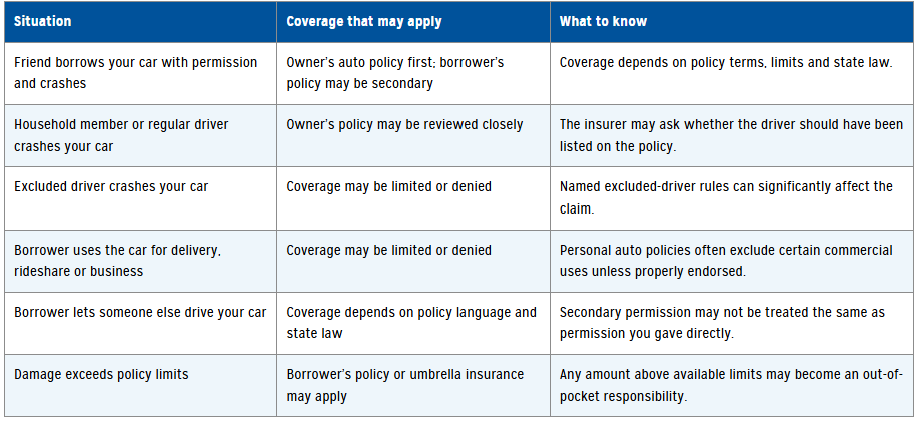
Quick coverage guide: What may happen after a borrowed-car crash?
What information will the insurance company need?
Borrower information: Name, license information, contact details and relationship to the vehicle owner.
Permission details: Whether permission was given, how it was given and whether there were limits on the trip.
Trip details: Where the borrower was going, when the crash happened and why the car was being used.
Accident evidence: Photos, videos, police report number, witness information and repair estimates.
Injury and damage details: Who was hurt, what property was damaged and whether emergency services responded.
Borrower’s insurance: The borrower’s policy information, if they have auto insurance.
Use of the car: Whether the borrower was using the vehicle for personal errands, commuting, delivery, rideshare or another business purpose.
What should you check before letting someone borrow your vehicle?
Do they have a valid driver’s license?
Do they have their own auto insurance?
Are they a household member or regular driver who should be listed on your policy?
Are there limits on where, when and why they can use your vehicle?
Will they use the car for delivery, rideshare or another business purpose?
Are they an excluded driver? An excluded driver is a person living in your household who is named on your policy as having no insurance coverage. An example is a household member with multiple moving violations.
Are your liability limits high enough for the risk of lending your vehicle?
Review your coverage before lending your car
If you lend your vehicle to a friend, relative, neighbor or coworker, review your auto policy first, so you understand who is covered, which uses are excluded and what limits may apply. Call and ask us whether regular borrowers, household drivers, excluded drivers, delivery or rideshare use, collision coverage and umbrella insurance should be part of your coverage review.
Compliments of AAA
Dan Zeiler
dan@zeiler.com
877-597-5900